Your Automation Is the Teacher Making the PB&J (AutoCon 6, Part 9)
Maximilian Francis’s AutoCon 6 lightning talk: automation executes literally, so turn the CLI veteran’s implicit steps into explicit, modular, fail-fast code. Why that matters even more once agents are involved.
part 9 of 11 · series AutoCon 6
- 1State of automation: start with your alerts
- 2Digital twins at scale
- 3Observability and blast radius
- 4AI evaluation
- 5Automation ROI
- 6Leading radical change
- 7Build vs. buy
- 8Wouldn't it be cool if...
- 9Lightning: the PB&J method
- 10Lightning: 3,000 routers
- 11Lightning: how much code is enough
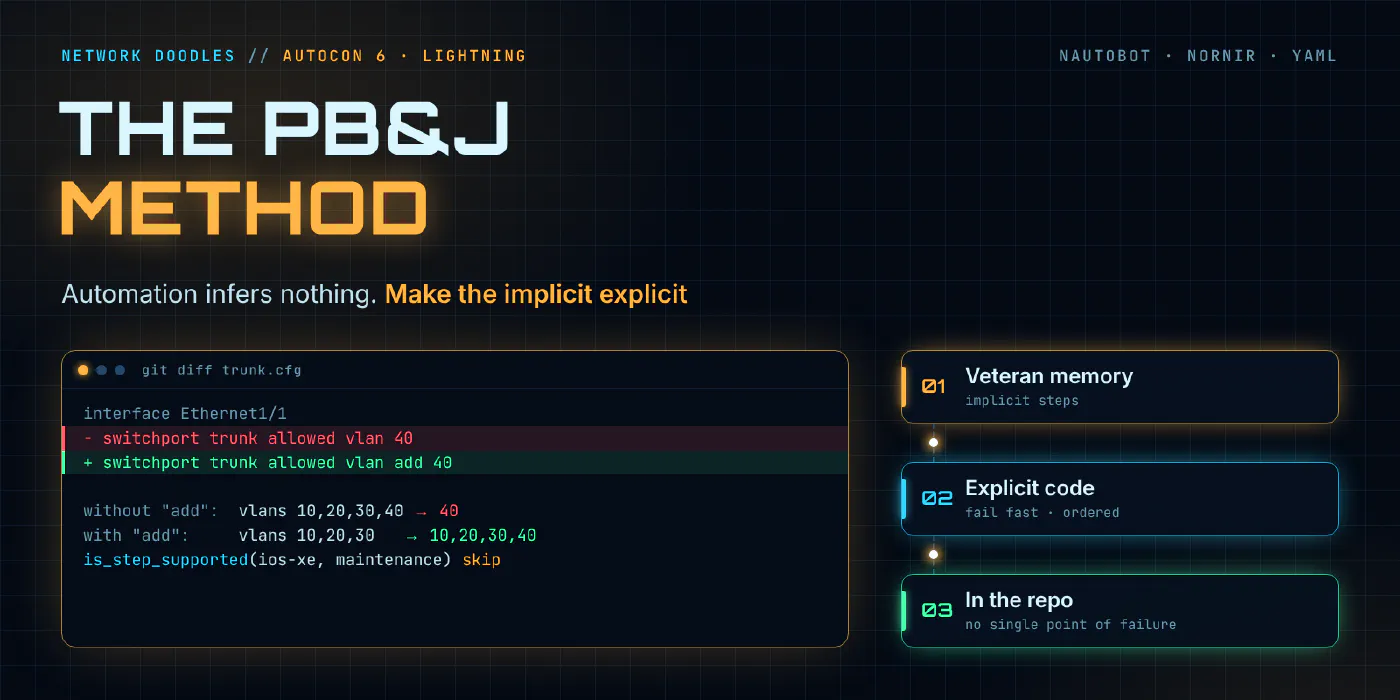
Maximilian Francis of Network to Code opened his AutoCon 6 lightning talk with the grade-school exercise most of us remember. Write instructions for making a peanut butter and jelly sandwich, then watch the teacher follow them exactly. Forget to say “take the lid off the peanut butter” and the lid stays on. The teacher infers nothing.
Automation works the same way. The interpreter can’t infer your intent, however good your docstrings are. In
networking a missing step carries a big blast radius: leave out add on a VLAN trunk command and four VLANs
become one.
How do you turn a manual network task into reliable automation?
- Research. Gather business requirements and audit the documentation. The 25-year CLI veteran on your team has steps memorized that never made it into Confluence. Turn those implicit assumptions into explicit code.
- Plan. Fail fast. Detect a bad condition and eject before touching production. Let task dependencies set the order.
- Build modular. Small reusable functions, promoted to shared libraries.
- Test until you’d run it in your sleep, and turn unexpected errors into handled exceptions.
His real example was an OS upgrade workflow in Nautobot: about 25 chained jobs defined in YAML, kicked off from
one intake job. Each step carries a weight, so reordering is a one-integer change. An is_step_supported check
skips steps a platform doesn’t support (Cisco IOS XE has no maintenance mode, Arista EOS does), and dispatch
patterns let one backup job handle both vendors. Platform three means adding an entry, not writing a new job.
My take: the PB&J problem gets worse with AI
The line that stuck with me: once that veteran’s knowledge is in the Git repo, it’s no longer a single point of failure. That’s the most underrated benefit of automation. It’s knowledge capture, and it outlasts the person.
The PB&J problem also gets worse with AI, not better. A literal machine skips a missing step and fails visibly. An agent fills the gap with a guess and keeps going. Explicit runbooks, ordered dependencies and fail-fast checks matter more when the thing executing them can improvise. That’s why I keep agents on the proposing side and leave execution to deterministic tooling that does exactly what it’s told. If your runbooks start as alert responses, writing down what you do when an alert fires is the same exercise as Maximilian’s sandwich instructions.
And if the steps live in YAML, read it the way the interpreter does.
This is part 9 of my AutoCon 6 series.
Related doodles
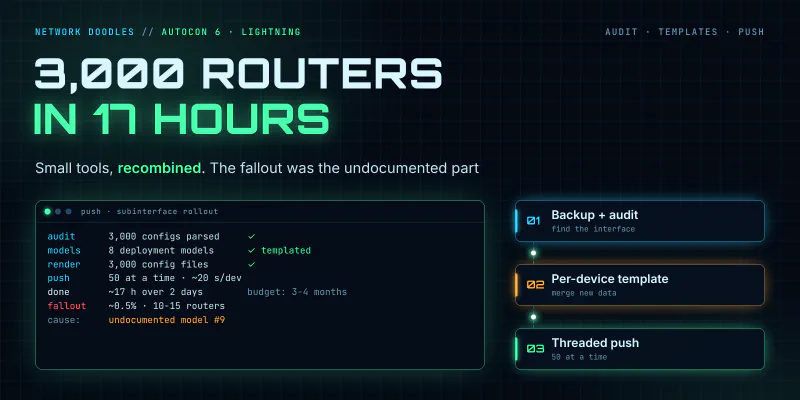
3,000 Routers in 17 Hours With Tools They Already Had (AutoCon 6, Part 10)
Mark Elias's AutoCon 6 lightning talk: how an AT&T team recombined backup, audit, config and push tools to change 3,000 routers in about 17 hours, and …
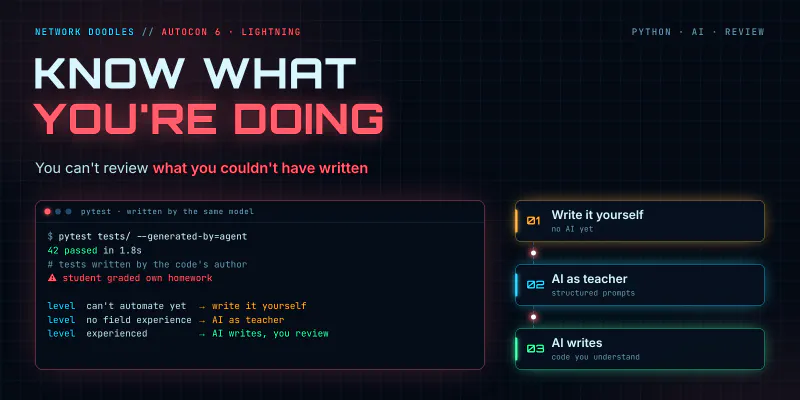
How Much Code Do Network Engineers Need in the AI Era? (AutoCon 6, Part 11)
Erika Dietrick's AutoCon 6 lightning talk: when to write the code yourself, when to let AI teach you, and when to let it write. Why you still have to …
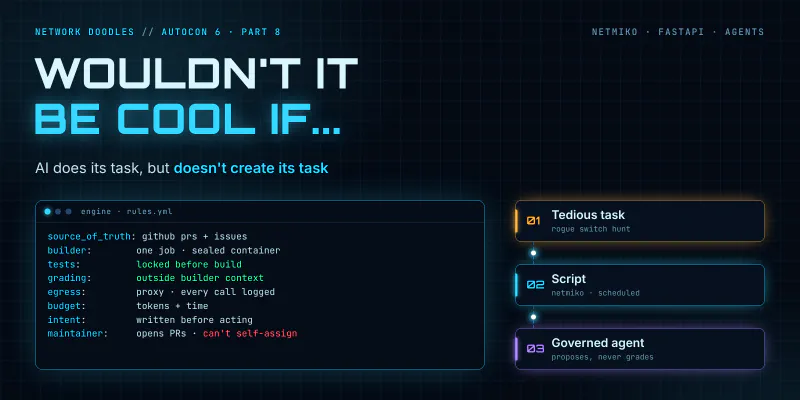
Wouldn't It Be Cool If...: From CLI to Agentic Delivery (AutoCon 6, Part 8)
Sean Mahoney's AutoCon 6 talk traced seven years from a tedious CLI task to an agentic software delivery engine. His rules for agents are the best I …