Wouldn't It Be Cool If...: From CLI to Agentic Delivery (AutoCon 6, Part 8)
Sean Mahoney’s AutoCon 6 talk traced seven years from a tedious CLI task to an agentic software delivery engine. His rules for agents are the best I saw all week, and his start looks a lot like mine.
part 8 of 11 · series AutoCon 6
- 1State of automation: start with your alerts
- 2Digital twins at scale
- 3Observability and blast radius
- 4AI evaluation
- 5Automation ROI
- 6Leading radical change
- 7Build vs. buy
- 8Wouldn't it be cool if...
- 9Lightning: the PB&J method
- 10Lightning: 3,000 routers
- 11Lightning: how much code is enough
One of my favorite talks at AutoCon 6 was Sean Mahoney of US Signal compressing seven years of his career into 30 minutes. Every step started with the same sentence: wouldn’t it be cool if there were a better way to do this?
How did one tedious task turn into an automation career?
It started with hunting rogue hubs and switches across about 1,000 switch stacks without turning on port
security. The manual way meant SSH into each switch, run show mac address-table, paste into a spreadsheet and do
some Excel magic. Netmiko made it programmatic. Regex, loops and dictionaries made it scale. The CSV module ended
the copy-paste. PySNMP and a scheduler turned it into an hourly job that emailed the team about new rogue devices.
A task that would have eaten hours of several engineers’ time just ran.
Then a Webex chatbot, built the day he saw the API demo at a 2020 bootcamp (he skipped the rest of the training). It went from Node.js calling Python, to Flask, to a FastAPI gateway, with TextFSM templates replacing regex along the way. Then local LLMs summarizing BGP trap triage, then AI-assisted coding, then an engine that chains headless Claude Code sessions to build software from a chat message.
My version
This talk hit home because my own start looked the same. I started automating small networking tasks back in 2012, but my first big automation project came in 2017, and it was one I decided was too big to do by hand: turning our Azure environment and our secondary data center into full disaster recovery failovers for production.
The servers were covered. The company bought Zerto to replicate them. But a server without the network around it is useless, and none of that was in sync: no DNS, no VIPs, no firewall rules, no VLAN or IPAM plan that matched between data centers, no routing, no public DNS and no dependency map. It all had to come up in a specific order, and the primary data center also carried dev and QA traffic that the app dev and SAP teams treated as production.
So I took it one layer at a time, in Python, Netmiko and Ansible. I automated collecting each production system’s config, then planned how each piece would translate to the DR site: firewall rules and NATs, VIPs with their iRules, health checks and pool members, the GSLB design and sync, the Nexus configs and routing. I met with every app owner to map frontends, app servers and databases. And I built in testing, because a failover you haven’t tested is a guess. In 2017 there still wasn’t much out there to copy for a job this size. I taught myself what I didn’t know and pushed the tools I did know into doing things I hadn’t thought of.
In the end we replicated and tested DR failover for more than 200 apps, every moving piece included, in one change window. Doing the first few by hand, I managed two or three per window, plus hours of collecting, parsing and converting data from the primary data center. My one regret is that I didn’t measure it, so the manual baseline is memory, not a number. That’s the mistake part 5 of this series warns about. If I can find the old code, I’ll sanitize it and post it, terrible mistakes included.
The best part came after. The automation became a formal process: new business-critical apps were built with automation that replicated and converted them to the other data centers at creation, and failover testing happened at turn-up instead of after the fact.
Once it worked, I kept going. I added monitoring, then I built an IPAM. None of it was planned as a program. Each piece solved the next annoying thing.
That’s how most real automation careers start, and it’s why the survey’s “half of organizations have no dedicated automation engineer” number, from part 1 of this series, bothers me. Curiosity builds the first tool. Someone has to own the tenth.
What rules keep an AI agent from grading its own work?
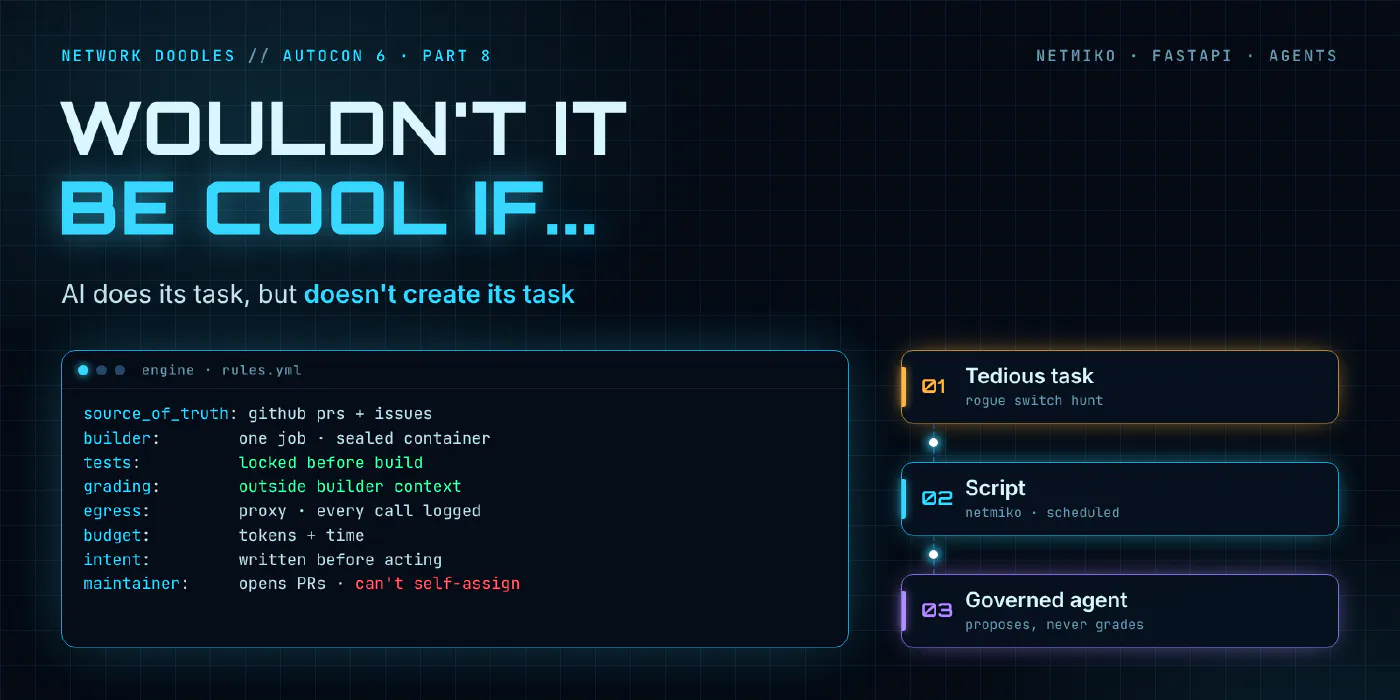
The best list I saw all week was his set of design principles for his current agentic delivery engine:
- GitHub (PRs and issues) is the source of truth, not handoff documents
- One builder, one job, in a sealed, network-isolated container
- Tests are written and locked before the build starts, and the builder can’t modify them
- Grading happens outside the builder’s context
- A proxy gates every external call and logs it
- The builder works on a copy, never live code
- Every builder gets a token and time budget
- The engine writes its intent before acting, so it can resume after a crash
- Shipped apps include a maintenance agent that can open PRs but can’t assign itself work
His summary: AI does its task, but doesn’t create its task. It writes tests, but can’t pass them itself.
That’s the same separation I argue for with network agents: proposing, approving and executing are different jobs, and the agent only gets the first one. I also liked his answer on LLM determinism for alarm handling. The LLM wasn’t troubleshooting. Scripts did the triage, and the model only summarized their output. That’s the right first job for an LLM in operations, and it’s the pattern I described in automating troubleshooting from your alerts.
One result worth noting: he wired up a script to generate 15 app ideas a day and got 30 apps in a weekend. About 10% worked. Building is no longer the bottleneck. Verification is, which is the whole argument of Eric Chou’s talk in part 4.
How does a mid-level engineer find time to learn automation?
Someone asked exactly that. His answer: volunteer for every tedious project nobody wants, then use the expected timeline as cover to experiment. I did a version of that myself, and I’d give the same advice today.
This is part 8 of my AutoCon 6 series.
Related doodles
Anthropic Agent Skills for Network Automation: Build Your First SKILL.md
Learn how to build Anthropic Agent Skills for network automation, including a complete SKILL.md example with NetBox queries, device config retrieval, …
3,000 Routers in 17 Hours With Tools They Already Had (AutoCon 6, Part 10)
Mark Elias's AutoCon 6 lightning talk: how an AT&T team recombined backup, audit, config and push tools to change 3,000 routers in about 17 hours, and …
Am I Just Playing It Safe? Build vs. Buy When AI Can Build Anything (AutoCon 6, Part 7)
Damien Garros's AutoCon 6 closing keynote asked what you should build when you can build anything. Dinesh Dutt and John Capobianco argued it out in …