Everything Is Working Exactly as Designed. That's the Problem. (AutoCon 6, Part 6)
Anna Claiborne’s AutoCon 6 talk on leading radical change, read as a network automation playbook: governance built to say not yet, sacred cows, the four-step answer to risk, and metrics that show real change.
part 6 of 11 · series AutoCon 6
- 1State of automation: start with your alerts
- 2Digital twins at scale
- 3Observability and blast radius
- 4AI evaluation
- 5Automation ROI
- 6Leading radical change
- 7Build vs. buy
- 8Wouldn't it be cool if...
- 9Lightning: the PB&J method
- 10Lightning: 3,000 routers
- 11Lightning: how much code is enough
The least technical talk I saw at AutoCon 6 might be the one most relevant to why network automation stalls. Anna Claiborne of Salesforce has led change as a startup CTO and inside large enterprises, and she opened with this: enterprises don’t fail to change because something is broken. They fail because everything works exactly as designed.
Why do enterprises resist change when nothing is broken?
Governance, process and risk management exist to keep the ship steady, and in good times they do it well. Approval gates catch bad bets. Standard workflows make outcomes repeatable. Risk management protects what already works.
| System | In good times | In radical change |
|---|---|---|
| Governance | Approval gates and steering forums catch bad bets | Every new idea waits for a forum designed to say “not yet,” and decisions move at meeting cadence |
| Process | Standard workflows make outcomes repeatable | The new way of working doesn’t fit the workflow, so it looks like non-compliance |
| Risk management | Limits the downside and protects what works | Measures the risk of acting, rarely the risk of standing still |
None of that is broken. It’s doing what it was built to do.
Is universal buy-in a realistic goal?
Universal buy-in is mostly a comforting story we use to put off hard choices. Some of today’s top performers won’t be top performers in the new model, and some of them are in the room.
Her “Survivor: Enterprise Edition” slide sorted people by how they handle change. The ones who thrive are builders, fast learners comfortable saying “I don’t know yet,” mission-first people who care more about the outcome than their title, cross-functional translators, data-driven realists willing to admit the data contradicts them, and leaders who share credit and take the heat. The ones who struggle are guardians of the old model, micromanagers, process-first operators who use policy and risk as a default no, chronic consensus-seekers who reopen every decision, status-dependent leaders, and leaders who can’t handle dissent.
What are sacred cows, and how do you break them?
A sacred cow is a product, customer, process or value that is never questioned, is protected by powerful stakeholders, and has no clearly stated value. The obvious ones are doomed legacy products and unprofitable “strategic” customers. The subtle ones are values:
- Stability becomes “my job is the process.”
- Efficiency refuses a short dip in performance for a long-term gain.
- Consensus becomes a steering committee with no decision-maker.
- Even modern values get bent: psychological safety read as never being uncomfortable, work-life balance as no urgent work ever, a flat hierarchy as a way to avoid hard decisions.
Her tools for breaking them: a hard sunset with a public feature freeze date for a doomed product, a small funded skunkworks team that works outside a resistant business unit, and decommission bonuses tied to retiring legacy systems on a timeline.
How do you move fast in a risk-averse enterprise?
How fast you can move depends on trust. High-trust organizations are collaborative, decentralized, focused on learning, and treat risk as opportunity. Low-trust ones are territorial, hierarchical, focused on blame, and treat risk as a problem.
For a risk-averse enterprise she offered four steps:
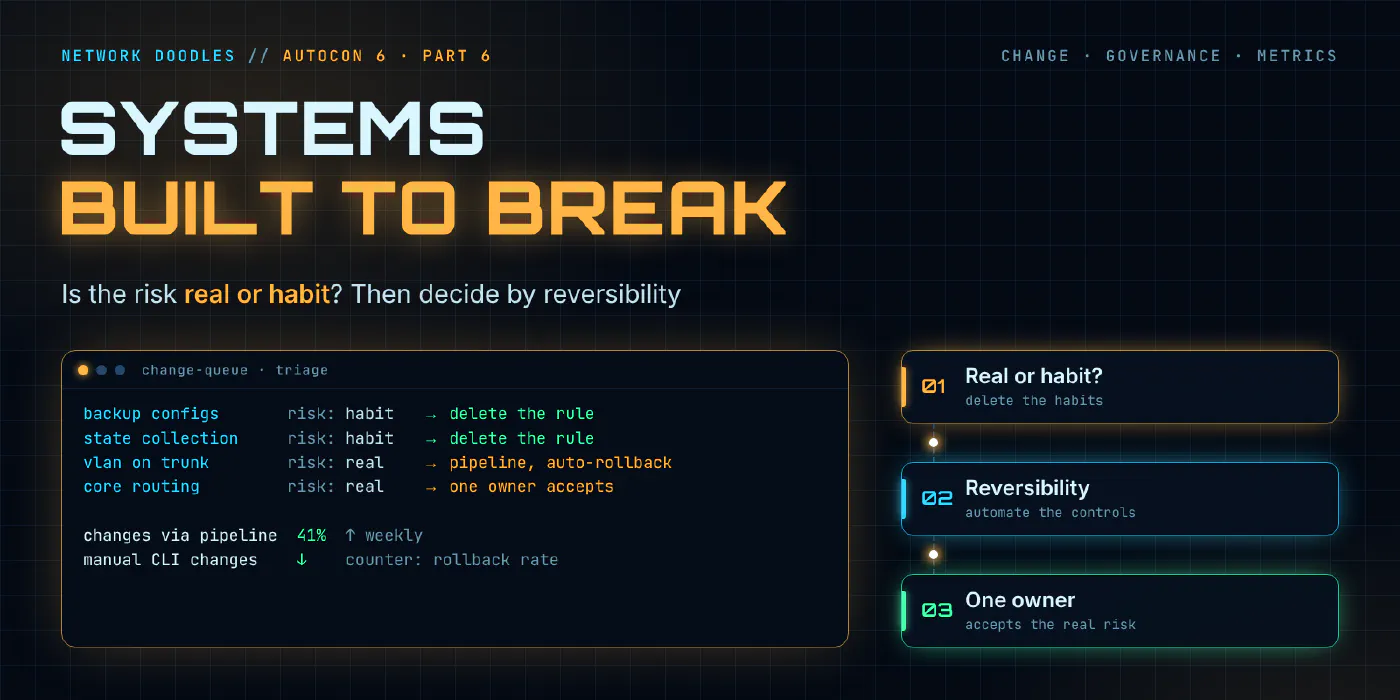
- Ask whether the risk is real or habit.
- If it’s habit, delete the rule and put a cost on standing still.
- If it’s real, change how it’s governed. Decide by reversibility, build risk into the team, automate the controls, and name one owner who can accept the risk.
- If the system won’t change, go around it with fast lanes, skunkworks or time-limited exceptions. As a last resort, spend trust deliberately.
Before spending trust, check whether the thing is breakable: is it a critical system, is it in the path of revenue, and what would happen if it went away tomorrow? Her rule of thumb: the more trust you’re about to break, the more communication and agreement-building you owe first.
How do you measure whether an organization is actually changing?
In radical change, the question shifts from “how are we performing?” to “are we actually changing?” She measures in three layers: behavior and adoption, the enablers (tech, process, skills), and business outcomes last.
Her how-to for leading indicators was the most practical slide of the talk:
- Tag systems and services as legacy or next-gen in your inventory.
- Track movement away from the old, not just use of the new.
- Pair every adoption metric with a quality or friction counter-metric.
- Pick metrics that move weekly, and aim for trend improvement.
- For each indicator, write down in advance what happens if it misses.
On the process side: lead time from idea to production, percentage of releases automated versus manual, time from issue raised to decision made, and percentage of experiments killed within 90 days. Lagging indicators like revenue and incident rates become guardrails, with an acceptable dip agreed up front.
My take: her step 3 is a network automation design doc
The survey earlier in the week, covered in part 1 of this series, said people problems outnumber technical problems four to one as the barrier to automation. This talk explained why.
Her step 3 reads like a network automation design doc: decide by reversibility, automate the controls, name one owner who accepts the risk. Read-only automation (backups, state collection, validation) is reversible. It shouldn’t wait in the same change advisory board queue as a core routing change, but in a lot of organizations it does, and the automation program dies there. And “automate the controls” is what a good pipeline is. Pre-checks, validation and rollback built into the workflow can replace a meeting as the control.
Her metrics translate almost word for word. “Releases automated versus manual” becomes the percentage of network changes that go through the pipeline instead of the CLI. “Track movement away from the old” means watching manual CLI changes go down, not just playbook runs go up. The counter-metric is change success rate or rollback rate, so speed doesn’t hide breakage. And tagging legacy versus next-gen in your inventory is exactly what your source of truth is for. If NetBox is already your inventory, it’s already where those tags belong.
Identity threat is the cultural barrier I see most. Engineers who spent 20 years getting fast at the CLI hear “automation” as “you’re less valuable.” The network version of “my job is the process” is the engineer whose value is knowing the MOP by heart. The answer isn’t a pep talk. It’s being specific, early, about what changes in someone’s job and what doesn’t, and making the people who capture their knowledge in code the visible winners.
The advice for leading change without authority matched what works in my experience: build peer pressure across teams, run a proof of concept that produces data, and go over a resistant manager’s head only as a last resort. Combine that with the ROI method from part 5 and you have a pitch: a small, measured win with honest numbers. That moves budgets.
One warning sign is worth repeating to any automation lead: if nobody pushes back and everyone is waiting for something to break, the change isn’t working. Make dissent safe. Run pre-mortems. Rotate who plays devil’s advocate.
Final Jeopardy
Anna closed with four questions on a Final Jeopardy slide:
- Which sacred cow do you need to question?
- Where are you choosing comfort over necessary change?
- Would you rather be loved (the nice leader) or remembered as the one who saved the company?
- If this company fails in 5 years, what will you wish you’d done differently right now?
The second one followed me into the next morning’s keynote on build vs. buy, where I wrote “Am I just playing it safe?” in my notes. That became part 7 of this series. Comfort and judgment look identical from the inside. The only way I know to tell them apart is to keep running experiments past the point I’d recommend to anyone else.
For network teams, the sacred cow is usually the process that has always worked: the hand-built MOP, the change window everyone works around, the CLI veteran nobody questions. Those aren’t bad. They were built to protect the network, which is exactly why they resist the change automation needs.
The last question is the one I’d put in front of an automation program. If your network operations look the same in five years, with the same manual changes and the same 2 a.m. troubleshooting, what will you wish you’d started this quarter? Write the answer down, then pick the smallest reversible version of it and do that first.
This is part 6 of my AutoCon 6 series.
Related doodles
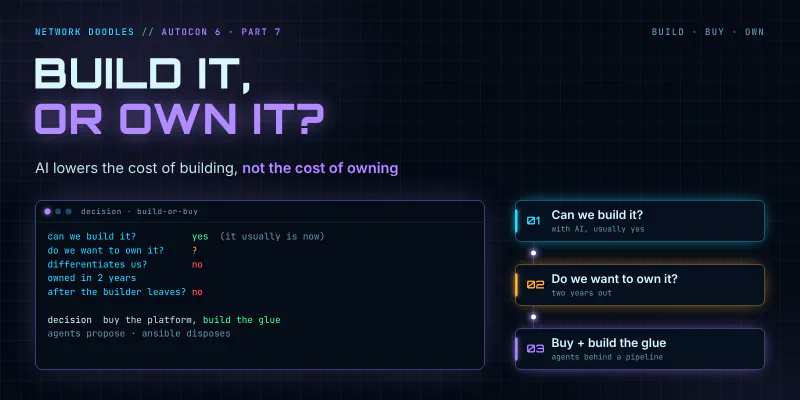
Am I Just Playing It Safe? Build vs. Buy When AI Can Build Anything (AutoCon 6, Part 7)
Damien Garros's AutoCon 6 closing keynote asked what you should build when you can build anything. Dinesh Dutt and John Capobianco argued it out in …
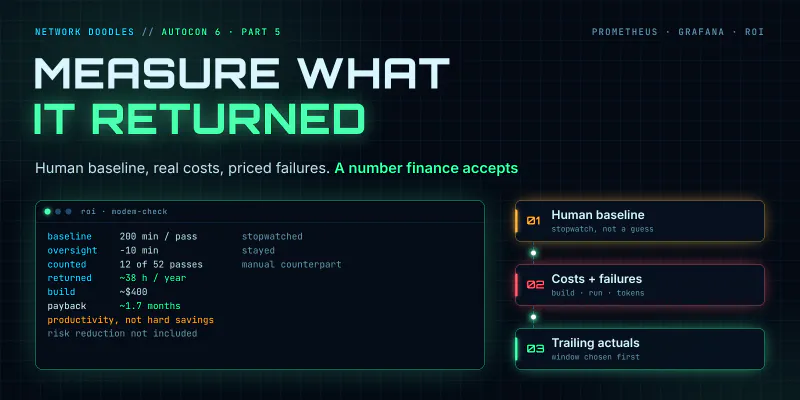
Your Network Automation ROI Number Is Probably Marketing (AutoCon 6, Part 5)
Jonathon Davis's AutoCon 6 method for measuring what an automation returned: a human baseline, oversight subtracted, real costs, priced failures, and …
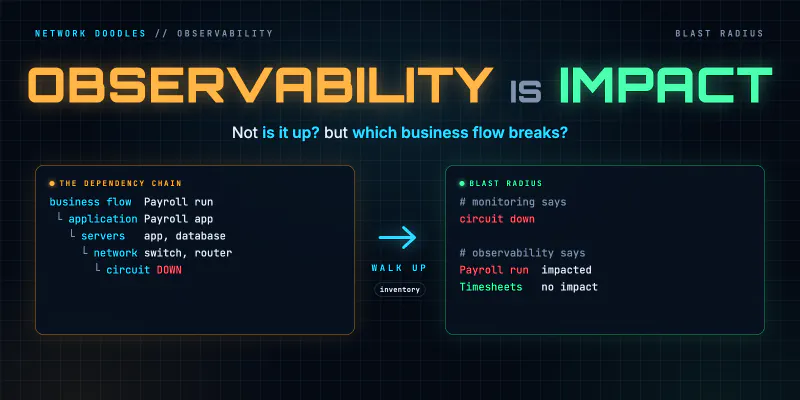
Observability Isn't Uptime: It's Knowing What Breaks the Business
Observability is uptime, monitoring and telemetry plus your inventory and business flows, so you can see which flow breaks when a switch, server or …