Am I Just Playing It Safe? Build vs. Buy When AI Can Build Anything (AutoCon 6, Part 7)
Damien Garros’s AutoCon 6 closing keynote asked what you should build when you can build anything. Dinesh Dutt and John Capobianco argued it out in the Q&A. Here’s where I land, and whether the middle is judgment or comfort.
part 7 of 11 · series AutoCon 6
- 1State of automation: start with your alerts
- 2Digital twins at scale
- 3Observability and blast radius
- 4AI evaluation
- 5Automation ROI
- 6Leading radical change
- 7Build vs. buy
- 8Wouldn't it be cool if...
- 9Lightning: the PB&J method
- 10Lightning: 3,000 routers
- 11Lightning: how much code is enough
I wrote three lines in my notes during Damien Garros’s closing keynote at AutoCon 6: Am I just playing it safe? Hanging in the middle. Do we think we are the exception? This post is me trying to answer them.
What should you build when AI lets you build anything?
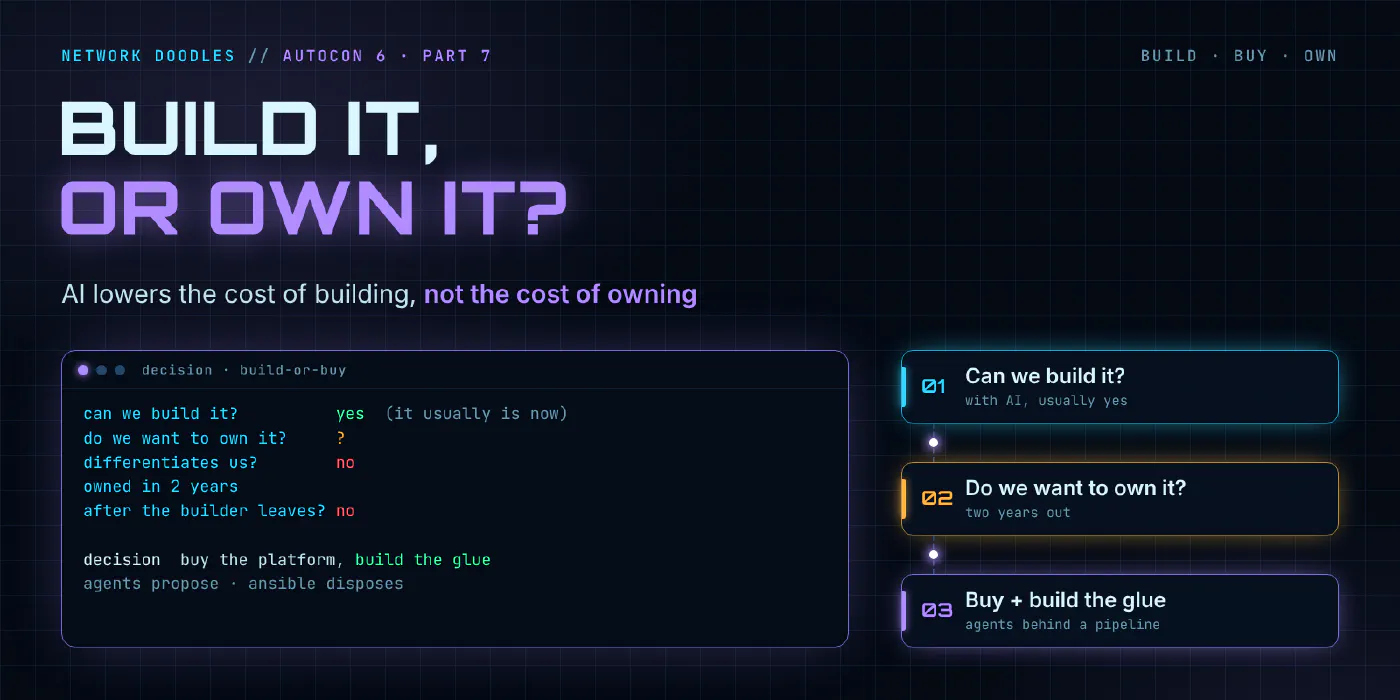
Damien, CEO and co-founder of OpsMill, reframed build vs. buy. The question isn’t “can we build it?” anymore, because with AI the answer is usually yes. The question is “do we want to own it?” AI lowers the cost of building. It doesn’t lower the cost of owning: funding it, understanding its decisions and maintaining it after the person who built it moves on. Vendors are adopting AI just as fast, with more people and more domain depth, so the builder’s edge is smaller than it feels. And there’s always a line. Nobody builds their own NAS or their own routing protocol.
His four predictions for software: quality goes up (bugs fixed in hours), value goes up (more for the same price), volume goes up (software for problems nobody solved before), and shape changes, with every component becoming a platform that agents extend and compose.
On working with AI as a coworker: delegate implementation, not trade-offs, goals or architecture. Review everything, because AI output often looks finished and has no door in the house. Match oversight to consequences. And don’t give agents direct access to network devices; route changes through backend platforms and version control.
Dinesh Dutt vs. John Capobianco: how fast should we move?
The Q&A turned into a debate between two of the most respected people in this field.
Dinesh Dutt took the skeptic’s side. Dinesh created SuzieQ, was a Cisco Fellow and chief scientist at Cumulus, co-authored the VXLAN and TRILL standards, and wrote Cloud Native Data Center Networking. His argument was that even OpenAI and the other labs couldn’t define clean boundaries for their agents, so claiming we can is wishful thinking. He reminded the room that networking has chased myths before, from standard interfaces to SD-WAN, and that the volume of AI-generated PRs, the outages and the immature tooling all argue for caution.
John Capobianco countered. John is Head of AI and Developer Relations at Itential, built the open-source NetClaw network agent, and has probably done more than anyone to bring MCP to network engineers. His answer was results: 20 video games, 90,000 lines of code and 1,600 tests rebuilt in two hours. The work is real, and it’s happening now.
Damien landed in the middle. Move as fast as you can sustain while still owning the outcome. If you can’t own the result, you’re going too fast.
Am I playing it safe?
My own position sits in the same middle. Buy the platforms, build the glue, and keep agents behind deterministic execution and human approval. Agents propose, Ansible disposes. I’ve written about building the glue myself, like an MCP server for network automation, and none of it replaces the platforms underneath.
So the fair question is whether the middle is judgment or comfort. Honestly, some of both. The middle is easy to defend in a customer meeting. Nobody gets fired for recommending human-in-the-loop.
Watching Dinesh and John go at it helped. Both are right, and that’s the point. Dinesh has spent a career watching the industry overpromise, and his caution comes from designing the protocols and data center fabrics the rest of us run on. John has spent the last two years shipping agents and MCP servers that actually work, and his impatience comes from seeing what’s possible. If I only listened to Dinesh, I’d never move. If I only listened to John, I’d move faster than my customers can own. The middle isn’t a compromise between them. It’s taking both seriously at the same time.
I think it’s still the right answer for production networks, for a reason the talk named: blast radius. A game prototype and a hospital network don’t deserve the same guardrails. But the middle is only judgment if I keep testing the edges. At home I run an agent with far more autonomy than I’d ever recommend to a customer, and that’s where I find out where the line actually is. If I stopped doing that, the middle would become a habit. The question I took from Anna Claiborne’s talk the day before applies here too: where am I choosing comfort over necessary change?
Do we think we’re the exception?
Every team building its own source of truth, its own agent framework or its own observability stack believes it’s the exception. Most aren’t. The test I’m going to use: two years from now, after the person who built it leaves, can the team still own it? If yes, and it’s where you differentiate, build. If not, buy, and put your build energy into the integration that makes the bought thing yours.
Curiosity came up as the core skill for keeping up, and Damien argued that new grads who think AI-native can outpace experienced engineers. Maybe. But they’re also missing the institutional knowledge of where the bodies are buried. The best teams I see pair those two on purpose.
This is part 7 of my AutoCon 6 series.
Related doodles
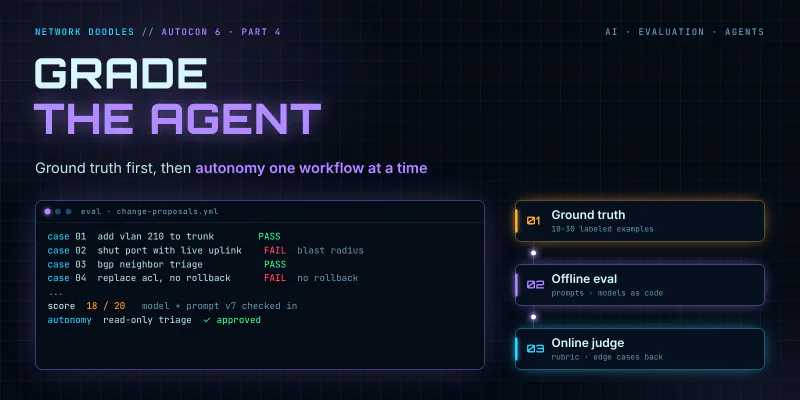
You Can't Tell an Agent Not to Hallucinate. You Can Grade It. (AutoCon 6, Part 4)
Eric Chou's AutoCon 6 talk on AI evaluation: why pilots don't survive production, the offline and online evaluation loop, and what it would take to …
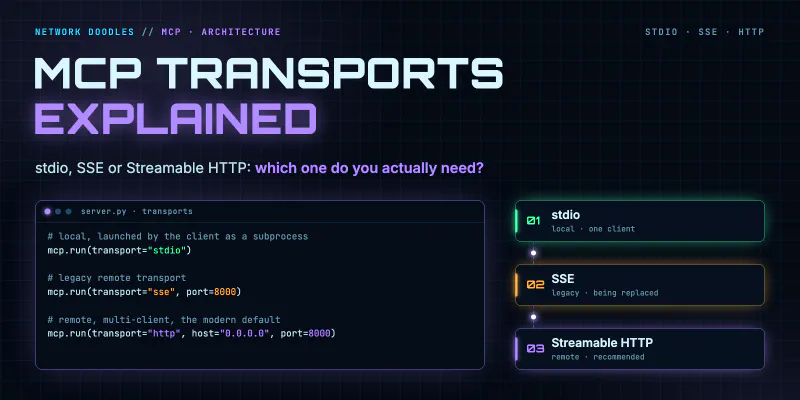
MCP Transport Types Explained: stdio, SSE, and Streamable HTTP. Which One Do You Actually Need?
A practical guide to MCP transport types, breaking down stdio, SSE, and Streamable HTTP with FastMCP configuration examples and a clear decision guide …
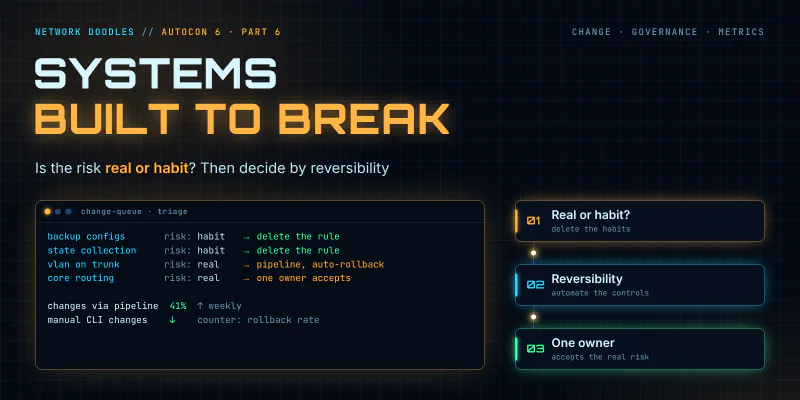
Everything Is Working Exactly as Designed. That's the Problem. (AutoCon 6, Part 6)
Anna Claiborne's AutoCon 6 talk on leading radical change, read as a network automation playbook: governance built to say not yet, sacred cows, the …