You Can't Tell an Agent Not to Hallucinate. You Can Grade It. (AutoCon 6, Part 4)
Eric Chou’s AutoCon 6 talk on AI evaluation: why pilots don’t survive production, the offline and online evaluation loop, and what it would take to trust my own home network agent with more.
part 4 of 11 · series AutoCon 6
- 1State of automation: start with your alerts
- 2Digital twins at scale
- 3Observability and blast radius
- 4AI evaluation
- 5Automation ROI
- 6Leading radical change
- 7Build vs. buy
- 8Wouldn't it be cool if...
- 9Lightning: the PB&J method
- 10Lightning: 3,000 routers
- 11Lightning: how much code is enough
Eric Chou opened his AutoCon 6 talk with a show of hands. Nearly everyone in the room uses AI. About five people have an agent doing real work for them. That gap is the whole talk.
Why don’t AI pilots survive production?
Pilots run on curated data and curated questions. Production brings edge cases and users who do unpredictable things. Eric called shipping without a validation framework “hope-driven development,” and named two failure modes: demos that don’t reflect real-world mess, and silent drift, where model updates, new tools and undocumented prompt changes ship with no measured impact. Both end the same way: lost trust, lost budget, stalled project.
Models are probabilistic. Most operations need to be deterministic. His line: 99% sounds great until your life depends on it.
How do you evaluate an AI agent before and after rollout?
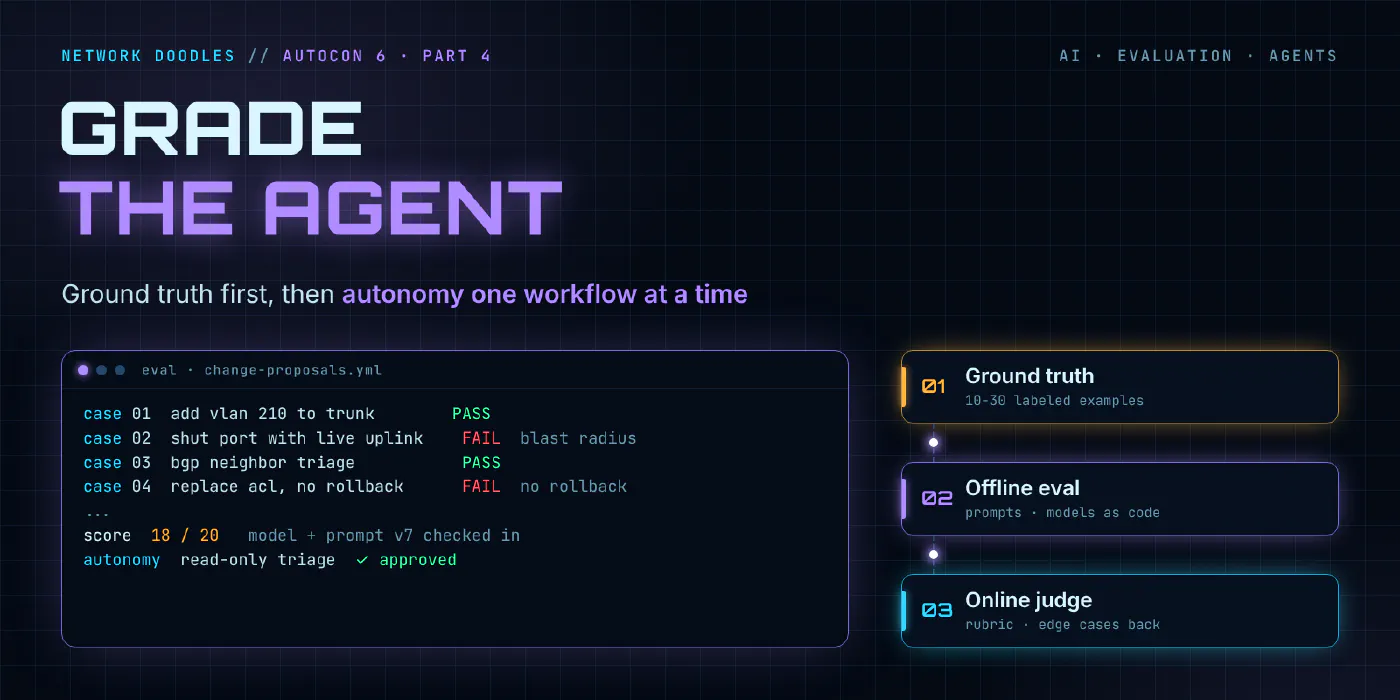
Start with ground truth. If you can’t write down what “right” looks like, you can’t measure it. Public leaderboards are a starting point. They test public data, not your data, your rules or your judgment.
| Phase | What you do |
|---|---|
| Offline, before production | Define the workflow and its business rules, build a reference dataset (real examples preferred), agree as a team on what good looks like, and iterate on prompts and models until the team accepts the results. Prompts and model choices get checked in like code. |
| Online, in production | Humans don’t scale, so an LLM judge scores traffic against a rubric. Log the traces that matter, classify the emerging problem buckets, and feed real edge cases back into the offline set. |
The case studies made it concrete. DoorDash routes high-severity responses (money, refunds) to a human in real time and cut hallucinations 90% and severe compliance issues 99%. Alibaba Cloud ran a network troubleshooting system in production for ten months before publishing, with 20% faster troubleshooting. A clinical note-taking system kept recording the wrong drug when a patient corrected themselves mid-sentence, which is exactly the kind of edge case only real traffic finds.
My take: my approval step is my evaluation, and that doesn’t scale
This is the missing piece in most agentic ops pitches, including some I’ve given myself.
At home I run my own agent harness on Claude’s Agent SDK. It has read access to my network monitoring and telemetry and no write path to the network at all. The only way it changes the network is by submitting a change through my CI/CD pipeline, which I approve or reject from my phone. That’s the same split I wrote about in From InfraGenie to ODIN: agents propose, Ansible disposes. On lower-stakes systems I give it more room. While I was in Tucson it recovered a failed server in my basement, rebuilt it on new hardware and migrated the apps without me touching anything.
What I don’t have is what Eric described. My approval step is my evaluation, and that doesn’t scale past one person. A labeled set of 20 good and bad change proposals would tell me far more than my gut does at 11 p.m.
That’s also the answer to the hallway conversation afterward. Most companies don’t stall in the operations team. They stall with upper management and security, who are paid to be risk-averse. If securing the environment were my job, I’d be cautious too. You don’t move those people with a demo. You move them with evidence, and an evaluation set is how you produce it. Autonomy should expand one workflow at a time, based on evidence instead of intuition. A good first workflow is the read-only one from part 1 of this series: collecting evidence when an alert fires.
What can you do on Monday?
Pick one workflow. Write 10-30 pass/fail examples of what right and wrong look like. Do it before the rollout, not after the first incident.
This is part 4 of my AutoCon 6 series.
Related doodles
Am I Just Playing It Safe? Build vs. Buy When AI Can Build Anything (AutoCon 6, Part 7)
Damien Garros's AutoCon 6 closing keynote asked what you should build when you can build anything. Dinesh Dutt and John Capobianco argued it out in …
Observability Isn't Uptime: It's Knowing What Breaks the Business
Observability is uptime, monitoring and telemetry plus your inventory and business flows, so you can see which flow breaks when a switch, server or …
Emulate the Question, Not the Network: Digital Twins at Scale (AutoCon 6, Part 2)
Russ White's AutoCon 6 tutorial built a butterfly fabric in ContainerLab and found where it breaks. The lesson I took home: build one twin per …