How Much Code Do Network Engineers Need in the AI Era? (AutoCon 6, Part 11)
Erika Dietrick’s AutoCon 6 lightning talk: when to write the code yourself, when to let AI teach you, and when to let it write. Why you still have to know what you’re doing, and why approval is the control that matters.
part 11 of 11 · series AutoCon 6
- 1State of automation: start with your alerts
- 2Digital twins at scale
- 3Observability and blast radius
- 4AI evaluation
- 5Automation ROI
- 6Leading radical change
- 7Build vs. buy
- 8Wouldn't it be cool if...
- 9Lightning: the PB&J method
- 10Lightning: 3,000 routers
- 11Lightning: how much code is enough
Erika Dietrick skipped the “is coding dead?” debate in her AutoCon 6 lightning talk and asked a better question: how much do network engineers need to know? Her answer is enough to think programmatically about the network. She lays it out as 11 foundational topics taught in network terms, from developer mindset and environment setup through data structures, troubleshooting, libraries, APIs and version control.
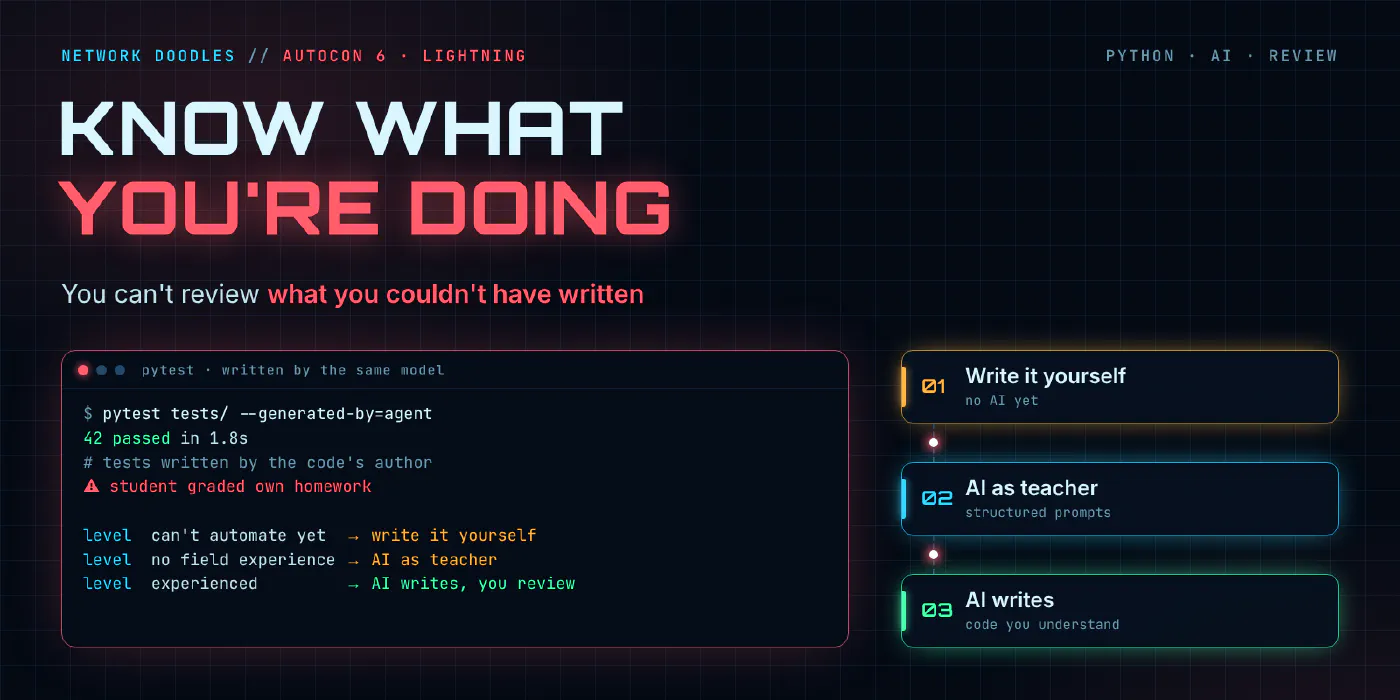
When should a network engineer let AI write the code?
| Where you are | What to do with AI |
|---|---|
| You can’t write working automation yet | Write all of it yourself. No AI. |
| You can write it but lack real-world experience | Use AI as a teacher, with structured prompts. |
| You’re an experienced automator | Let AI generate code you already understand. |
Then she went through the objections one at a time. What about vibe coding? Not reviewing the code isn’t safe for infrastructure. AI agents, agent loops, a spec written by a software engineer? You still have to know what you’re doing. Skills and rules files? Useful, but in her experiment, telling a high-end model to look for specific issues gave it tunnel vision and it missed others.
The line of the week for me: an AI that passes 100% of the tests it wrote itself is a student grading its own homework.
My take: you can’t review what you couldn’t have written
I agree with all of it. Her test is the one I’d use for hiring and staffing: you can’t review what you couldn’t have written. If a team member can’t read the playbook an agent produced, they can’t approve it, and approval is the only control that matters.
The self-graded-tests point ties to the best engineering pattern I saw at the conference, from Sean Mahoney’s agentic delivery talk: tests are written and locked before the build, and grading happens outside the builder’s context. Separate the thing that produces from the thing that judges. Eric Chou’s evaluation talk makes the same argument for agents in production.
Her closing point is the one I’d tape to the wall. We’re engineers. We’re responsible for the network, not the AI. That’s the whole reason I keep execution deterministic and keep a human on the merge. Agents propose. Ansible disposes. People own the outcome.
Her iDoIt program (Level 1 is 12 weeks of video, exercises and a mentor conversation; Level 2 is self-paced with a prompt guide) is free. Worth sending to anyone on your team who’s starting out. If they’re starting from zero, the fundamentals in YAML for network engineers and keeping passwords out of playbooks are where I’d point them first.
This is part 11 of my AutoCon 6 series.
Related doodles
Emulate the Question, Not the Network: Digital Twins at Scale (AutoCon 6, Part 2)
Russ White's AutoCon 6 tutorial built a butterfly fabric in ContainerLab and found where it breaks. The lesson I took home: build one twin per …
Wouldn't It Be Cool If...: From CLI to Agentic Delivery (AutoCon 6, Part 8)
Sean Mahoney's AutoCon 6 talk traced seven years from a tedious CLI task to an agentic software delivery engine. His rules for agents are the best I …
You Can't Tell an Agent Not to Hallucinate. You Can Grade It. (AutoCon 6, Part 4)
Eric Chou's AutoCon 6 talk on AI evaluation: why pilots don't survive production, the offline and online evaluation loop, and what it would take to …