lesson 3.1 · chapter 3 of 7: antennas and patterns · 35 min
Antennas and patterns: dBi, donuts and beams
objective
Explain what dBi measures and why antenna gain is focus, not extra power; picture an omni’s donut pattern and the hole above and below it; tell a wide beam from a narrow one; and read the two polar plots on an antenna datasheet.
What does an antenna actually do?
A lamp and a flashlight
A bare light bulb lights the whole room a little. Put the same bulb in a flashlight and it lights one spot a lot, and the rest of the room hardly at all. The bulb didn’t get brighter; the reflector focused it.
An antenna is the reflector. The radio supplies the power; the antenna decides where it goes. That’s the most important idea in this lesson, so it’s worth saying twice: antenna gain is focus, not extra power.
in one sentence The radio makes the power; the antenna aims it.
dBi: compared with a perfect bulb
To say how much an antenna focuses, engineers compare it with an imaginary isotropic antenna that sends exactly the same amount in every direction, like a perfect bare bulb floating in space. It can’t be built, but it makes a handy yardstick. dBi means decibels compared with isotropic:
- 0 dBi: the same as the imaginary bulb.
- +6 dBi: in its best direction, four times stronger than the bulb (+6 dB, from lesson 1). Somewhere else it has to be weaker, to pay for it.
So when a datasheet says 6 dBi, it means in its best direction. Every gain in this course is in dBi.
in one sentence dBi is gain in the best direction, compared with an antenna that sends the same everywhere.
The radiation pattern
An antenna’s radiation pattern is a 3D shape: how strongly it sends in each direction. The common ones:
| Antenna | Shape | Peak gain | Good for |
|---|---|---|---|
| Dipole (the classic stick) | a donut, with a hole straight up and down | 2.15 dBi | general use, standing upright |
| High-gain omni | a flatter donut, a wider hole | about 6 dBi | reaching far along one floor |
| Ceiling AP antenna | aimed down, strongest 45° below | about 4 dBi | office ceilings |
| Patch | a wide beam one way | about 10 dBi | a hallway or a room from one wall |
| Yagi or sector | a narrow beam | about 15 dBi | a long warehouse aisle |
Omni (short for omnidirectional) means it sends equally all the way around the horizon. It doesn’t mean equally in every direction: an omni’s pattern is a donut, not a ball.
in one sentence Omnis make donuts with holes above and below; directional antennas make beams.
Beamwidth
A beam doesn’t stop sharply. Its beamwidth is measured between the points where the signal is 3 dB below the peak, half the power. A 65° patch is still sending a little at 80° off center, just less. And the narrower the beam, the higher the gain, because the same power is squeezed into less space.
Most directional antennas also send a little backwards. The difference between front and back is the front-to-back ratio, often about 20 dB.
in one sentence Beamwidth is measured at half power, and narrower beams have more gain.
Polarization, and many antennas at once
Radio waves wiggle in a direction too: an upright antenna sends vertically polarized waves, and receives them best. A laptop’s antennas point every which way, and walls and furniture scramble polarization indoors, so indoors it rarely matters much. Outdoors, on a long point-to-point link, both ends must match.
Look inside a modern access point and you’ll find two, four or eight antennas, not one. They work together (MIMO, multiple input, multiple output) to send several streams of data at once. They still add up to roughly the shapes in the table above.
in one sentence Indoors, polarization is scrambled anyway; modern access points use several antennas together.
Reading an antenna datasheet
A 3D shape is hard to print, so antenna datasheets slice it twice and draw each slice as a round polar plot:
- Azimuth (also called the H-plane): the pattern sliced flat, seen from above. For an upright omni it’s a circle: the same all the way around.
- Elevation (the E-plane): the pattern sliced upright, seen from the side. For an upright dipole it’s a figure 8 on its side: strong toward the horizon, nothing straight up or down.
The rings are usually in dB below the peak: the outer ring is the peak, then −10, −20, −30 dB. A shape that reaches the outer ring in some direction is at full strength there; one that shrinks to the middle sends almost nothing.
The 3D view below draws both: the full shape, and underneath it the two slices, the way a datasheet prints them.
in one sentence Azimuth is the pattern from above; elevation is from the side. Rings are dB below the peak.
Turn the patterns around
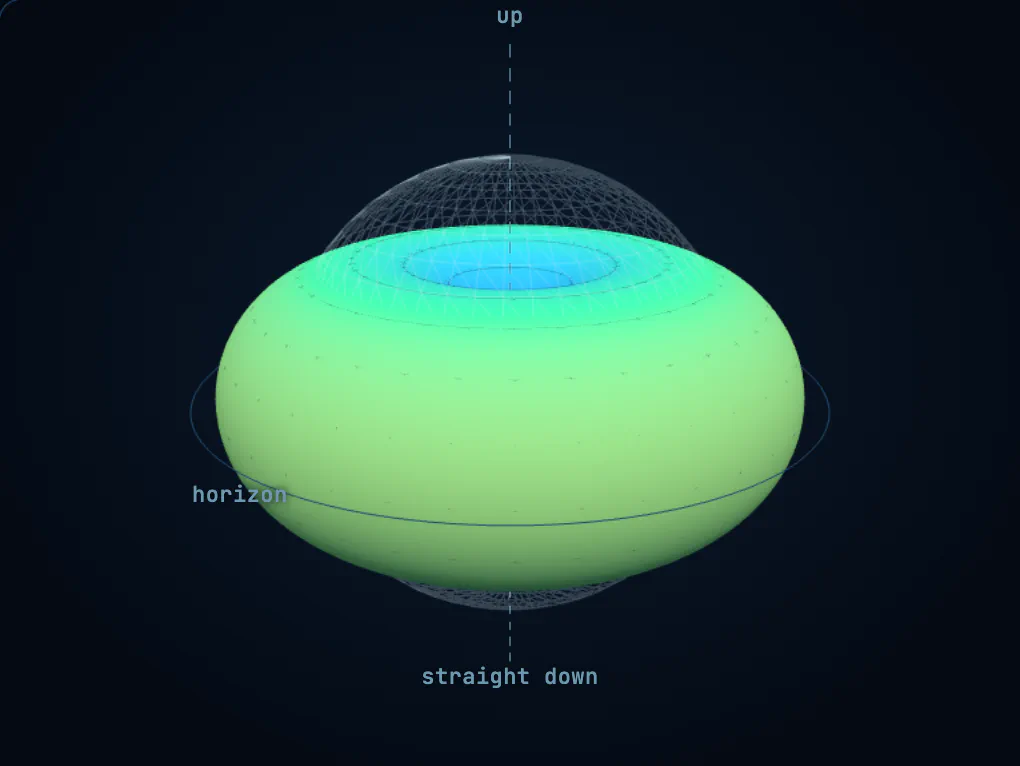
Press Start the 3D lab, then try these:
- Dipole. Drag to turn it. It’s a donut, with a hole straight up and straight down. Point at the hole: about 25 dB weaker than the horizon. Its azimuth slice is a circle; its elevation slice is a figure 8.
- Isotropic. A perfect ball, the 0 dBi yardstick. The faint sphere around every other pattern is this ball.
- High-gain omni. A flatter donut that pokes out farther along the horizon (6 dBi) and pulls in above and below. Same power, different shape.
- Ceiling AP. Tipped down, strongest about 45° below the horizon, with only a shallow dip straight down. That’s the shape you want hanging from an office ceiling.
- Patch and Narrow beam. Beams along the orange boresight line (the direction the antenna points). Point at the edge of each beam: 3 dB down at 32° off for the patch, 15° for the narrow beam.
The 3D shape shows reach: how far the signal goes in each direction before it fades to the same level. The flat slices are in dB, like a datasheet.
Now see what a donut’s hole does on a real floor. This task hangs a dipole 20 ft up in the office from lesson 4.
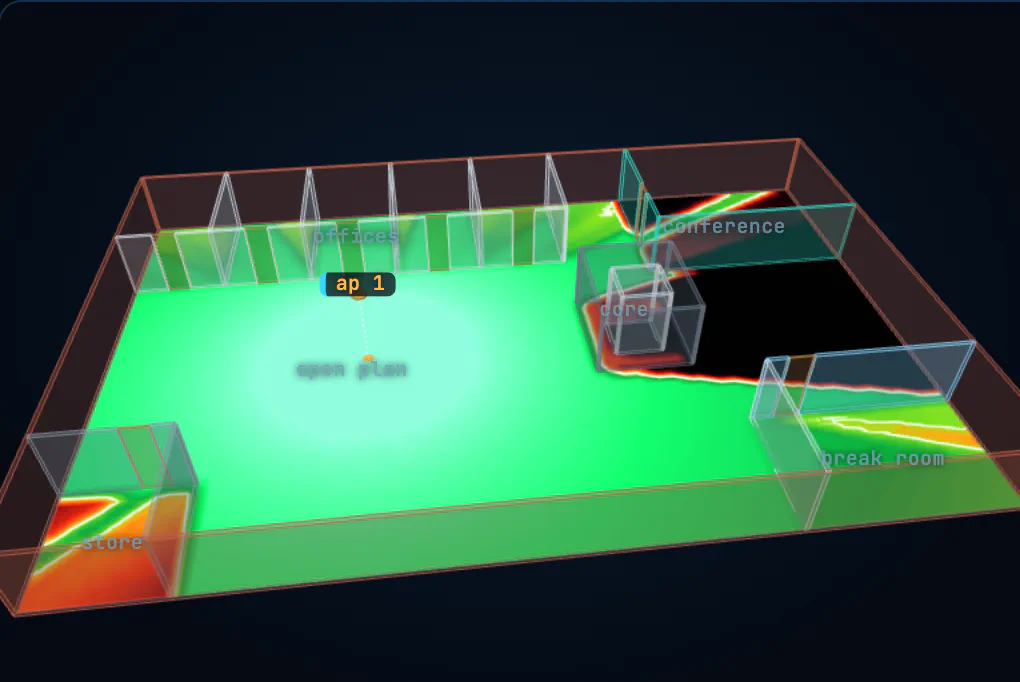
Find the hole under the AP. Put the laptop on the weakest spot within 10 ft of the access point. Click the floor to put the laptop down, then press Check.
in one sentence A dipole’s hole points at the floor when you hang it from a ceiling.
Which antenna?
Pick an antenna for each, and say why:
- A long, narrow warehouse aisle, with the access point on the wall at one end.
- An open-plan office, access points on the ceiling.
- A hallway 120 ft long, the access point at one end.
- A café, the access point on a shelf in the middle of the room.
hint
Ask two things each time: where’s the access point, and what shape is the space you need to fill?
show the solution
- Narrow beam (Yagi or sector). The aisle is long and thin, so a 30° beam aimed down it puts the signal where the people are and keeps it out of the neighboring aisles. Lesson 5 tries this.
- Ceiling AP antennas, aimed down. A plain dipole would point its hole at the people underneath.
- A patch: a 65° beam from one end fills a hallway nicely. A narrow beam would also reach, but more of the hallway near the access point would fall outside it.
- An omni standing upright, like a dipole. The room is all round it on one level, which is exactly the donut’s strong ring.
Back to lesson 2 for channels, or on to lesson 4, where the signal meets walls. EIRP from lesson 1 is transmit power, minus the cable, plus exactly this gain.
5 check: test yourself
Pick an answer for each question. You'll see straight away whether it's right, and why. Questions marked what happens next? are about the animations.
what happens next?What does a 6 dBi antenna do compared with a 2 dBi one?
An antenna can’t make power. Gain is focus: more in some directions means less in others.
Where does an upright dipole send almost nothing?
Its pattern is a donut around the antenna, with a hole straight up and straight down, along the antenna itself.
A patch antenna has a 65° beamwidth. What does that number measure?
Beamwidth is measured at the half-power points. There’s still signal outside it, just less.
An antenna datasheet shows two round plots. What are they?
Together the two slices describe the 3D shape. An omni’s azimuth plot is a circle; its elevation plot is a figure 8.
What’s 0 dBi?
The i is for isotropic. A real dipole is 2.15 dBi: 2.15 dB better than the isotropic yardstick in its best direction.